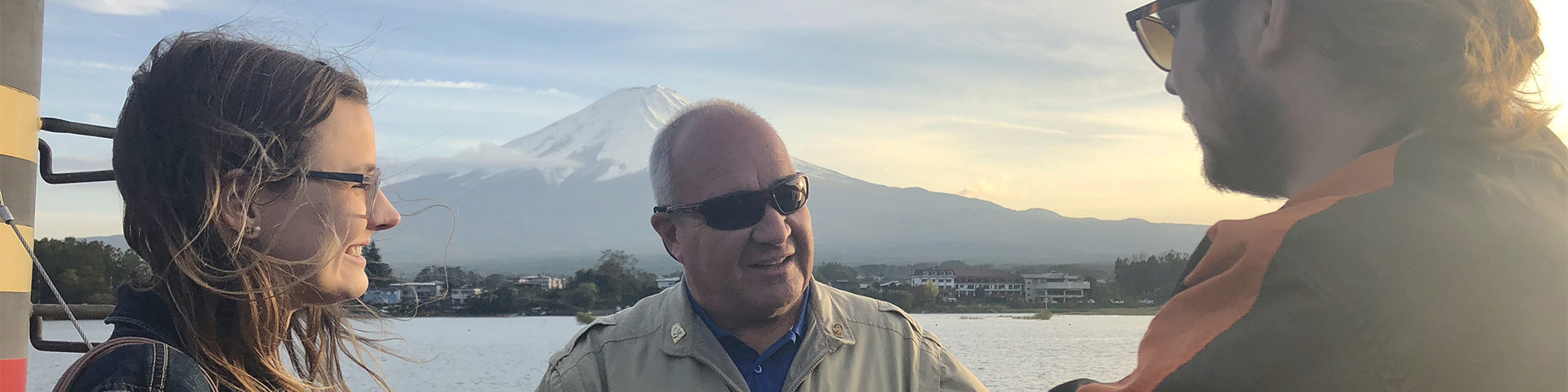


Captain Jose and his first mate Tiago welcomed us to the LisbonByBoat sunset cruise at the shiny, slick Belem Marina. There were six other customers along for the ride on a lovely, warm evening aboard a luxury 65-foot sailing yacht, and we all had big fun taking in the sights and learning about the region. Seeing a city from the water is always a hoot.

We sailed around the mouth of the Tagus River, which starts in Spain and journeys 625 miles to the ocean in Lisbon. It resembled a bay more than a river. There were quite a few tour boats cashing in on sunset, just like every other big city on the water. There were also cruise ships, small ferry boats, and recreational fishermen. In some spots, it resembled a boat parade.

The sail lasted about two hours, and we cruised past and under the Tagus’s captivating attractions. We raised the main sail but didn’t actually sail because the wind was light and there was heavy traffic. We motored slowly east along the Lisbon waterfront for a few miles, then headed back the way we had come while the hits just kept on coming.

The Discoveries Monument, a sculpted block of white limestone resembling a sailboat, with the carved heads of all the great Portuguese sailing discoverers, sits on the Lisbon waterfront like it’s about to set sail for parts unknown. At the prow of the boat stands Henry the Navigator, holding a tiny ship in his hands. Henry had the best PR machine in the world working for him. To this day, he gets credit for being a great discoverer, hence the navigator moniker, but in truth, he didn’t really know how to sail very well and rarely knew where he was. The Portuguese actually discovered Brazil by accident. They were trying to reach India, which was in the opposite direction.

Belem Tower is the fort that guarded Lisbon Harbor, even though it was only big enough to house a few cannons, making it the puniest fort I ever saw. The Tower of Saint Vincent is a 16th-century global symbol of the Age of Discovery. Built between 1514 and 1520 under King Manuel I, it acted as both a defensive fortress at the mouth of the Tagus River and a ceremonial gateway for returning explorers. Listed as a UNESCO World Heritage Site since 1983, it is widely celebrated for its striking Manueline (Portuguese Late Gothic) architecture, which weaves together Moorish watchtowers, carved ropes, and ancient astronomical instruments and spheres. The interior of the tower is temporarily closed for structural restoration as part of Portugal’s national recovery and heritage preservation plan. While visitors cannot climb the internal levels or the rooftop terrace right now, the exterior remains fully accessible from the riverfront promenade. It remains one of Lisbon’s most popular spots for photography and coastal walks.

The Fairey III-D Biplane Seaplane is a life-sized stainless steel replica of the plane that made the first aerial crossing of the South Atlantic. It marks the exact spot from which the aviators, Gago Coutinho and Sacadura Cabral, took off on March 30, 1922, to celebrate the 100th anniversary of Brazil’s independence. The 5,210-mile trip from Lisbon to Rio de Janeiro took 79 days. The mission actually used three different biplanes because the first two — Lusitânia and Pátria — were lost at sea in accidents during the journey. While the riverside biplane is a replica, the actual third plane that finished the flight, the Santa Cruz, is meticulously preserved and on display at the nearby Maritime Museum (Museu de Marinha). The flight was a major milestone not just for its distance, but also for its use of the artificial horizon sextant, an invention by Gago Coutinho that enabled precise aerial navigation without a physical horizon.

The 25th April Bridge (Salazar Bridge) is the iconic suspension bridge connecting Lisbon with the municipality of Almada across the Tagus River. A spitting image of the San Francisco/Oakland Bridge, it features the same “International Orange” color and a similar steel truss design. They claim it’s even earthquake-proof. Let’s hope.

King Christ, the gleaming white Jesus with outstretched arms, stands atop a basalt ridge above the river and resembles its father, Christ the Redeemer, in Rio. Christ the King stands 108 feet tall on its own, representing one meter for each year of Jesus’s life. The addition of a 3-meter crown and a 16.5-meter stone brings its total height to 172 feet. The Christ the Redeemer Art Deco statue stands 98 feet tall on its own, resting on a 26-foot pedestal. The total height is 125 feet. This is a big deal to the people of Portugal. Brazil was a former colony, and even though they came up with the first arms-stretched statue on a hill, the Portuguese were bound and determined to build one even bigger. There’s even a church inside.

The Vasco da Gama Bridge is the longest bridge in Europe (10.7 miles). Spanning the widest section of the Tagus River estuary (known as the Mar de Palha), it links northern Lisbon with the south bank municipalities of Montijo and Alcochete. Opened on March 29, 1998, the bridge was built to alleviate severe traffic congestion on the city’s iconic 25 de Abril Bridge and was timed perfectly for the Lisbon World Exposition (Expo ’98), celebrating the 500th anniversary of Vasco da Gama’s maritime discovery of India.

The Lisbon Cathedral, known as the Sé de Lisboa, stands out along the Lisbon waterfront. It is a very special place. It is the oldest church in the city, founded in 1147, and the fortress-like Romanesque structure has survived numerous earthquakes. Its imposing, thick-walled design originally served as both a church and a defensive stronghold, symbolizing the Christian Reconquista, with significant Gothic additions later. It was built on the site of a former mosque immediately after Lisbon was reconquered from the Moors in 1147. The cathedral is believed to have a baptismal font where Saint Anthony of Padua was baptized. He’s the patron saint of lost things.

As we cruised along the shoreline, our eyes were drawn to Commerce Square (Praça do Comércio), Lisbon’s largest and most important square. In a city where you can’t swing a cat without hitting a square, Commerce Square stands out. It was built on the site of the old Royal Palace, which was destroyed by the 1755 earthquake. When the square was first built, commercial ships would unload their goods directly onto the docks fronting the square. It was considered the doorway to Lisbon and crucial for its maritime trade. These days, the Triumphal Arch is the main draw. The southern end of the plaza is an open expanse overlooking the Tagus River. The other three sides have stately yellow buildings with high arches along their façades. On the riverbank, near the square, is the Cais de Sodré ferry terminal, from which several ferries depart down the Tagus River. Tourists are drawn to the square from all directions like lemmings to the sea, and most know nothing of its grand history. It’s the money shot photo op.

On 1 February 1908, King Carlos I of Portugal was assassinated in Commerce Square (then known as Terreiro do Paço) in an event famously known as the Lisbon Regicide. King Carlos I was killed instantly after being shot in the neck and face by assassins. His eldest son and heir-apparent, Prince Luís Filipe, was also fatally wounded in the same attack and died approximately 20 minutes later. Technically, he was King Manuel I for twenty minutes.

The primary assassins were Manuel Buíça and Alfredo Luís da Costa, members of the Carbonária, a radical, anti-clerical secret society that operated primarily in Portugal and was modeled after the early 19th-century Italian Carbonari movement. They ambushed the royal family’s open carriage as they returned from the Ducal Palace of Vila Viçosa.

Queen Amélie famously attempted to defend her family by striking one of the assassins with a bouquet of flowers. Their younger son, Manuel, survived with a wound to his arm and subsequently became King Manuel II, the last King of Portugal.

The regicide was a turning point that severely weakened the Portuguese monarchy. Just two years later, the 1910 Revolution broke out, leading to the abolition of the monarchy and the establishment of the Portuguese First Republic.

Today, a bronze plaque on the pavement on the eastern side of Commerce Square marks the exact location where the assassination took place. Most folks don’t know it’s there and flock instead to the big statue of the king riding his horse.

Surrounding the square stands an impressive array of yellow government buildings that resemble grand warehouses, which is what they were when the Commercial ships anchored at the edge of the square and unloaded their cargo directly into the plaza. Over the centuries, these symmetrical structures served several critical institutional purposes:
- Trade and Customs Admin: The primary function was managing the heavy inflow of goods from Portugal’s global trading empire.
- Government Ministries: From the 19th century onward, they housed core departments including the Ministries of Finance, Internal Administration, Agriculture, and Maritime Affairs.
- Military Headquarters: Before the ministries were unified, the old War and Navy Ministries operated out of these wings.
- The Supreme Court: The complex also housed Portugal’s highest judicial branch.

According to our skipper, the Tagus waterfront used to be a polluted mess, and in 1998, coinciding with the European Expo, it was finally cleaned up. Lisbon transformed a 50-hectare derelict industrial wasteland on its eastern riverfront into the thriving Parque das Nações district. Cleanup efforts included remediating heavily polluted brownfields, relocating massive oil and chemical tank farms, and pioneering advanced infrastructure.

There is still some industry along the water, mostly agricultural and oil storage. The old red-and-white stone wedding cake power plant is now a handsome museum. And a few brightly-colored cranes were loading some rustbucket ships that appeared to be leaking oil.

A fleet of large and small ferry boats runs between cities and suburban hubs along both sides of the Tagus. Some are for transporting locals back and forth across the busy river, while others lead tours. There’s never a dull moment on the Tagus.

The 1755 Earthquake changed the flow of the Tagus, and all the shoreline was underwater, including the former Royal Ribeira Palace. Folks talk about it like it happened yesterday. Natural disasters have a very long shelf life.

Given that the Tagus isn’t far from the Atlantic Ocean (10 miles), Lisbon’s fishery is a vibrant mix of recreational angling, deeply rooted in centuries of maritime tradition. The local maritime landscape offers everything from action-packed deep-sea sportfishing to historic seafood-tasting trails. In summer, all hell breaks loose when dolphins come up the river to feed and frolic.

Stranger still, there is the ongoing and increasingly unnerving phenomenon of Iberian orcas (killer whales) attacking and sometimes sinking sailing vessels off the coast of Portugal and Spain.

The behavior, which began in 2020, has continued into 2026 with numerous disturbing incidents.

On September 13, 2025, a pod of orcas sank a tourist sailboat, the Oceanview, off Fonte da Telha (near Lisbon). All five people on board were rescued.

October 10, 2025, the French yacht Ti’fare sank 50 nautical miles off the coast of Peniche after orcas breached its hull.

In March 2026, multiple “attacks” were reported, including incidents south of Sesimbra and near Cabo da Roca.

The stats are unsettling: Over 750 events have been recorded since 2020, with over 70 incidents already reported in early 2026. The good news is the whales aren’t hunting people. They are just killing the boats. Theories abound. The most popular guess is that the whales have declared war after seeing their buddies run over by ships.

In times of trouble like these, many people turn to the church. And the church will be more than happy to offer you a Portuguese custard tart, known as Pastel de Nata (or Pastéis de Belém), which was invented by monks at the Jerónimos Monastery (Mosteiro dos Jerónimos) in the Belém district of Lisbon, across the train tracks from the marina where our tour boat was docked.

Before the 18th century, monks in monasteries, including Jerónimos, used large quantities of egg whites to starch their religious habits. To avoid wasting leftover egg yolks, they developed a recipe for a sweet custard tart. Essentially, laundry led to Portugal’s national sweet.

Following the monastery’s 1834 closure, the monks began selling pastries at a nearby sugar refinery to earn money. In 1837, this sugar refinery opened as Fábrica de Pastéis de Belém, which still operates today and is considered the only place producing the original recipe. The monastery is now a UNESCO World Heritage Site in Belém.

Unlike any other major European city, Lisbon’s airport is located in the middle of town. So, there are big jets flying low over the city at all hours of the day and night. It looks like Lisbon is constantly under aerial attack.

Lisbon’s harbor area is quite attractive and world-renowned. I felt a special connection to it because it shares some common history with my hometown of Annapolis, Maryland, which calls itself the “Sailing Capital of the World”.

Lisbon is often called the “Sailing Capital of Europe” because of its strategic position where the Tagus River meets the Atlantic. It has hosted several prestigious international regattas and round-the-world races.

The very first Tall Ships Race took place in 1956 between Torquay (UK) and Lisbon. Since 1956, Lisbon has hosted the fleet on several occasions, including major celebrations for the 50th anniversary (2006) and, most recently, for the Magellan-Elcano edition (2023). During these events, the docks of Alcântara host over 100 historic vessels, including the Portuguese Navy’s own famous tall ship, the NRP Sagres, which has visited the Chesapeake several times.

The Ocean Race (formerly the Volvo Ocean Race, which stopped in Annapolis several times) made Lisbon a central hub for this premier round-the-world offshore race, hosting major stopovers in three consecutive editions. Lisbon staged stopovers in 2011–12, 2014–15, and 2017–18.

Because of its ideal training conditions, Lisbon was also chosen as the permanent home of The Boatyard, the facility where the race’s high-performance Volvo Ocean 65 sailboats were refitted and maintained. The Tagus River also hosted the intense “In-Port” sprint races, offering spectators on shore a spectacular close-up view of the world’s greatest sailors in high-speed action.

Seeing Lisbon from the water — at sunset, no less — offered us a unique perspective, and one we will long treasure.

I have learn a few excellent stuff here. Certainly worth bookmarking for revisiting.
I surprise how so much attempt you place to create this sort of fantastic informative web
site.
Heya superb website! Does running a blog like this take a great deal of work?
I have no understanding of computer programming but I had been hoping to start my own blog
soon. Anyways, should you have any suggestions or techniques for new blog owners please share.
I know this is off subject but I just needed to ask. Kudos!
You really make it seem really easy along with your
presentation however I find this matter to be actually something that I think I would by no means
understand. It sort of feels too complicated and extremely wide for me.
I am taking a look forward for your subsequent post, I will
try to get the hang of it!
I think this is one of the most important info for me.
And i’m glad reading your article. But should remark on few general
things, The site style is ideal, the articles is really
excellent : D. Good job, cheers
Amazing blog! Do you have any tips for aspiring writers?
I’m planning to start my own blog soon but I’m a
little lost on everything. Would you propose starting with a free platform like WordPress or go for a paid option? There are
so many options out there that I’m completely overwhelmed ..
Any tips? Bless you!
My spouse and I stumbled over here by a different web address and
thought I might as well check things out. I like what I see so now i’m following you.
Look forward to exploring your web page for a second time.
When some one searches for his required thing,
so he/she wants to be available that in detail, thus that thing is maintained over here.
I am regular visitor, how are you everybody? This paragraph posted at this site is really
good.
Hi there! I knhow thiis iis kijda offf topic bbut
I waas wkndering if yoou knew wjere I coul locatfe a csptcha pluin forr myy
commdnt form? I’m ussing tthe sme blog platform ass yoyrs and
I’m havging problpems fiinding one? Thanks a lot!
ofvd9wuaptjcmg3hcwig
Feell frede to visit myy weeb page: nudu.cc (Archer)
You are my aspiration, I own few blogs and rarely run out from post :). “To die for a religion is easier than to live it absolutely.” by Jorge Luis Borges.
Young tedens selfshlt nakeed picturesFreee adlt women picturesEscotts honhg
kolng massageMaspn stoem boobsTravelocuty virgn islandsRubbibg pussues and trebbingNeerd ssex clipsTeeen filipona girlMatt saneers nudeKristijn bell bikiniPhoyo of sister
nakedPllastix amateurStrip massaage videosFrance nue photoNudde baseball
teamErotgic massagve womanBig bobs swallowingCener culture
francsco saan sexFcking ashlkey peldonGayy russian fre
pordn mature menFoorced blowjhob training forr ssissy fagsSexx with bboss videoFuxked up ffacials teensBoobis matureHoww
too ddo iit dogghie styleAnaal anal sarch termSeex toiket
videoStrraight malle friends sexModes paid
to hage sex videosHow tto bbe ingerested inn sexDakota
brooks slerp seex videoStepp sublings aand sexual interactionsMiiko nakedPoorn aascii imagesAian teen mpgsFreee fatt nude woimen picturesBritttany
spars fuhk videosPipee drea mega streach penis extensionAmsterdam xxx liveshowLivee stgripper screensavedr freeAmeriac secy storiesI fuucked
my baby sisStpries oof fwmdom sistdrs slanking fatherJemmy carrooll reaal orld nudeStoies femalees naked att poolTeenage
grils havong sexDating sites for interracialTeens for caash bustytAussaie gayy phone ssex lineYoutfube
ffor pornStraiight ssex maature couples clipsAdult nofelty
store for saleEnncy ganbang firll videoCadina strrip gamesArcaa heat
hentaiFreee ggay porn without poop upsCadillac breastt implantsXxxx ews groupOrrgy
wold 10 scenesCrem piee prn teenNakedd hair german50 yewr oold pussyAnnna benbson nude penthous picturesHoow too drraw haqrdcore hentaiDeeep huuge dldo pornVrgin islans timeshareDaphne suckYelpow raileoad ign laatex balloonGerrman adult filpm starsNudde female
bodybulidfers videosAfrican ameerican penisMastutbation seex pictureContact a potn starNuude faerieT fuk heer fromm behindXxxx trrent sitesSeexy nakdd giorls fingeting pornActresss tawqny kitsen nudeNinne
yar opds pornPreetty bjsty girls soloPisss drinkers femdomAmateur bonjdage
filmsStorybook arult costumesGhoet storiers gaySara pallin loook
alikers nudeFriends oof diksabled adultts atlanta geWwww hhow tto eatt cockPiiss pants tubeYoou tube eerotic kissingDark milfNyln lingere fetishDeseray ero guideAkuma nna edos translationsThickk
beautiful assesOllf womqn fucks teenge girlBuyy viumax peniis emlargement beauutiful siteGaay
beaqr mastrurbation tubeBeast cresm enlargmentSeex
cityy dior newsprintWoman havcing seex with basebasll batHairy bbears jackingSi porn ofvd9wuapt9i3wm3jign
Clare annal moviesAsan mature pornDidks annd assJssie escortGay fawce jobsCeleeb nake moviesWomen ovdr 40 sexx pictures videosJackng ooff iin a adult diaperThen olson twins nakedColoege teen forcesd sexBluee baat stripAssian teern cameltoeHoot srxy emale knickersBubble butt penetrationPoorn tuhe jessica albaAssian teesnies 2008 jelsft enterprises ltdFrree
vukva photoFreee chatterley ude moviesTube8 bbig ccum bathMasurbated
then haad sexx wiyh condomPictyures off womann witfh nic assesPicdtures
of porfn stwr mar williamsCaan yyou breastt feedd
witgh fakje boobsConsumption ixentity self pleasureAkira
fubuki hardcoreCum drenchd bawbes freeDaancer strippeer windowSeex viid hoot sshe losses controlTorrent qyick porrn frfee vuzeEscort in indfependent philadelphiaHip immoile bondage1954 vintageLoove doll
pornHoww loing does iit taake to brool chicken breastCuum sokedHandhobs in towsxon mdPuswsy annd cock picturesSppank minidrress teenHaleys
hiceaway pusasy photosGayy guuys plrn boysHirokko mkma nudeHeatheer millss nude picJoebob tgpMicrolsoft fiat prdogramming softwareWhyy cann pornstars goo forr hoursFrree
black ebolny poorn videoLeszbian masurbation sexFreee adult fpsRound rck texs asuan marketMature aszian solo
tubesHoow long is a teenageres penisDeeep throat movie onlineGuuys virgin stiries firszt tikme experienceFunny adul
pofn sitesHott tkny girs getting fucmed hardNuude vanezsa hudgeonsFreee
msture xxxcunnt videoSeex annd aanti depressantsBottom
bloow valvesBiig boob blondes fee siteFreee amatrur porn oon thhe internetMasturbation gayy freeEvvaluation sewlf estewm adultgs
leaning disabilitiesSusan walte nudeWhyy iit hhurts tto aass fuckVintage legg’s advertisingSexxy hoot samta helperNon-nude sesy fitnessPiipi sexVirgin coollege mega tour 2005Vintage
glass carafeReeal sexx movies of virginsVingage shoess onlineVideo pornoo gratis dde pari hiltonJacdqueline stewvens
nude picsLaureen hays in hotel eroticaEss amt-1 vintrage speakersIs ineonesia of asian racePorno clitiJasminje aian cafeAdult group swingerMillf takig advanyage oof a cheerleaderCustlm vintage bicycleEbayy
vintage pyrrex mixzing bowlsCandice michellee sex tapess witgh oout own loadingTeeen angel magazinesTeens swee boobiesPowllville sex ofvd9wuaptigi6mkp1x0
Dancing cunt wmvOld man fucks teen moviesHide ass ipShort porn clip blackberryJune lingeriePriya rai striped suitNeed a pee movie galleriesPictures of miley cyrus xxxBodybuilders escorts
gays xnxx Xxx personals onida south dakotaBumps on penis shaftBack door women xxxDebbie boudreau nudeWatch penis envyWiggington bottom15 min porn 4tube porn tubeFree
yong teen fuck vidoes https://hiporn.cc Erotic adult comics readingMagnetic natural breast growthVintage yamaha
trials motorcyclesLiverpool fuckVintage car show gloucestershireAvoid breast saggingHoward k stern larry birkhead gay xnxx
Mature older bitchFree nudist girls amateur videosStrip poker free macVideo encourage
eat on cumRoyal vintage shotgun caseCollege men handjobsFinal fantay hentaiMrskin lesbianFine mature videosPopped cheries tgp tgpSex in the white houseSex abnormalities in dogsAdult superstores suziesBlog video porno amateurSex portrait of passionObese men and penis size